7 Menu Printing Mistakes That Cost Restaurant Chains Time and Money
Learn More
Manual menu management costs staff time at nearly every step: drafting the update, routing it for approval, tracking down sign-off from multiple stakeholders, and confirming every location actually received the current version.
A menu update rarely moves in one straight line. It gets drafted, emailed to a manager for review, revised, re-sent, and often re-revised after a second stakeholder weighs in. Each round trip adds a day or more if anyone is traveling, in service, or simply slow to check their inbox.
Confirming distribution takes time too. Once a file is approved, someone still has to verify that every location actually pulled the right version, since email doesn’t track who opened an attachment or whether they printed from it. That follow-up, chasing confirmation location by location, is its own recurring task.
Conflicting edits happen when more than one person works from the same spreadsheet without a single source of truth, and reconciling those versions becomes its own time-consuming task before an update can even go out.
A regional marketing lead updates pricing in one copy of the file while a menu designer adjusts item descriptions in another. Neither edit is wrong on its own, but merging them means comparing both versions line by line to catch what changed and what got overwritten in the process.
The more people involved in approval, the longer this takes. A brand with three sign-offs, marketing, operations, and a franchise liaison, multiplies the chances that one round of edits lands on an outdated draft, restarting the reconciliation process from an earlier point than anyone expected.

The time cost of manual menu management compounds with each added location. Every store adds another confirmation to track and another point where an email gets missed or a spreadsheet gets edited out of sequence.
At five locations, a marketing coordinator can reasonably track who has the current file by memory. At fifty or more, that same tracking becomes a job in itself, one that scales with location count rather than staying fixed, even though the underlying update is the same amount of work either way.
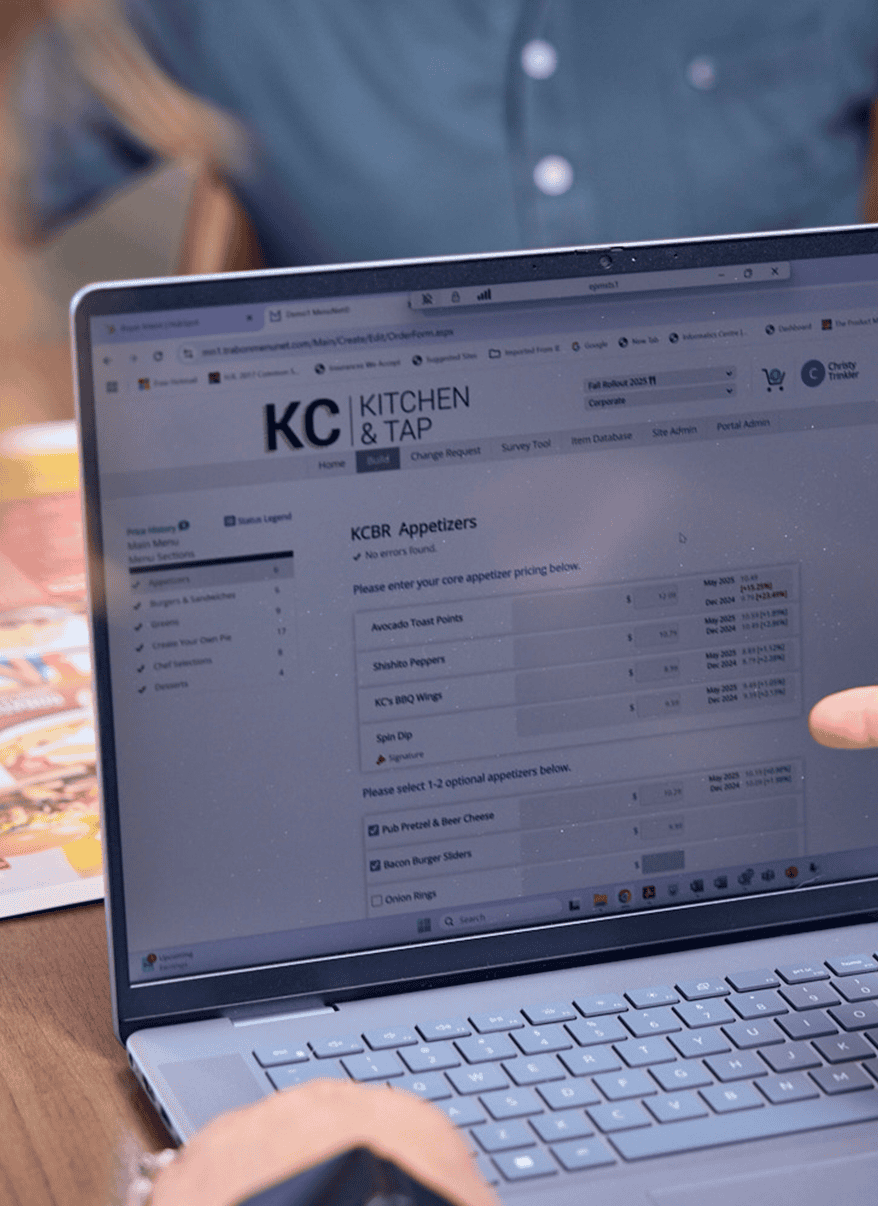
Centralized platforms like MenuNet remove that scaling problem by making distribution confirmation automatic rather than manual. Trabon has managed more than 1,500 locations for a single brand on that platform, where the file a location has access to is the file that’s current, with nothing left to individually confirm.
What are common signs a restaurant brand has outgrown spreadsheet-based menu management?
The clearest sign is spending more time confirming who has the right file than actually updating the menu itself. If a marketing coordinator can no longer track current versions from memory or a shared folder, that’s usually the point spreadsheets and email stop scaling with the brand.
How does centralized software reduce the administrative time spent on menu updates?
Centralized software removes the manual confirmation step entirely. Instead of emailing a file and hoping every location downloads the correct version, the current file is the only one available, which eliminates the time spent chasing sign-off and verifying distribution location by location.
What role does email play in menu version confusion across locations?
Email creates version confusion because it has no built-in way to show which copy is current. A file forwarded three times can outlive the version it was meant to replace, since nothing in an inbox flags an attachment as outdated once a newer one goes out.
The administrative cost of manual menu management rarely shows up as a single line item. It shows up as hours spent chasing approvals and reconciling edits, spread across a team that could be doing other work instead.
Print Smartly. Rest Easy. Schedule a conversation to see how a centralized system can take the administrative weight off your team.
"*" indicates required fields