Custom Kitting Solutions
Read Case Study

Multi-location brands never really set out to build a long vendor list. It usually happens one job at a time. Every step does solve an immediate problem, but it causes things to get messy when print orders are spread across four companies.
The problems show up in several places:
Across a busy promotion calendar, this consumes more of your time and puts deadlines at risk.
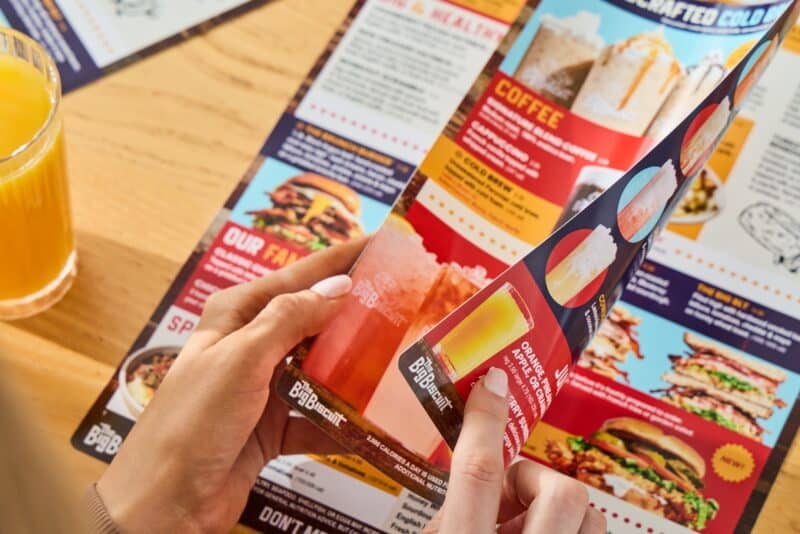
Printed color changes with the press, paper, ink, and calibration, so a logo file sent to three printers can come back in three slightly different shades, even when the artwork itself never changed. The variation becomes most obvious when a menu sits beside a table tent or sign produced somewhere else.
Giving the full program to one printing company puts every piece under the same color standards. Menus match the signage around them, and the next reorder looks like the run that came before it.
A regular account rep at one printing company learns the details that otherwise have to be repeated with every order: approved stocks, brand colors, common quantities, proof contacts, and delivery requirements. New projects can move straight into the work because the basics are already settled.
If you spread one campaign among four vendors, your team has four conversations to manage. Each supplier sends its own proofs, follows its own schedule, and asks its own round of questions. None of those tasks is especially difficult, but the trouble is that they keep returning, week after week, and can quietly take over a large part of someone’s job.
File confusion can turn an ordinary pricing update into an expensive reprint. Perhaps the latest artwork reaches two vendors, but the third still has an older file. The mistake may not be noticed until dozens of locations open boxes of menus carrying last month’s prices.
A consolidated program works better because it gives every order one approved source. Old artwork can’t reappear through a forgotten online printing company login or a file saved on a former employee’s desktop. Your team knows exactly which version will go to press.
Print orders contain plenty of details: dimensions, stocks, quantities, finishing instructions, approval notes, and shipping addresses. Passing the same information through several companies multiplies the chances of one detail getting lost or entered incorrectly.
With one vendor, your team sends the information once, reviews one coordinated set of proofs, and has one place to check when a question comes up. Fewer handoffs give errors fewer places to happen.
Of course, consolidation only works if one partner can produce the whole range of materials your locations use. Trabon Group has worked with multi-location restaurant and retail brands since 1975. We run digital and offset presses in the same Kansas City facility, allowing short and long runs to follow the same color standards. One rep can coordinate the account, while nationwide shipping gets each order to the locations that need it.
This connected system works perfectly for files and reorders. MenuNet keeps menu information versioned by location, so teams can tell which data is current, and PrintNet lets individual locations order approved materials on demand and gives the brand inventory alerts and order tracking.
If your print program has turned into a patchwork, talk to Trabon about bringing it together. We’ll look at what you order, how often it changes, and where it needs to go, and then map out a simpler program.
Vendor lists often grow after someone quickly searches for “printing companies near me” whenever the brand enters a new market. A local printer may serve one restaurant perfectly well. Once a brand has 30 locations, the harder job is keeping those locations consistent through every rollout, update, and reorder.
Trabon supports more than 80 national restaurant brands as a custom printing company for multi-location operators. A capable custom printing company should be able to keep production, menu tools, and nationwide distribution connected. Before another search for printing companies near me adds one more supplier to the list, request a quote from us and find out what you could simplify by putting menus, signs, and collateral with one printing company.